
(23 August 2000)
This view is looking timetable north; only a couple of feet beyond
the far end of this train, the track ends. Note the construction
going on down by the water; those are apartments, and down there is where
Gåshaga brygga will be located. On the right in this photo,
you can just glimpse the Gåshaga station building.
One interesting thing about Gåshaga, as it currently works, is
the signaling arrangement. A train approaching Gåshaga from
Talludden will normally cause the signal governing entrance to Gåshaga
to turn green, assuming there is no obstruction (e.g., another train) on
the track in the station. When this train enters Gåshaga, the
entrance signal turns red (of course), but at the same time, the exit signal,
previously red, automatically turns green behind the train. You can
see this in the train's rear-view mirror on the left side. It's also
possible to permit one train to pull into Gåshaga behind another,
but in order to do this, a little switch inside the station building must
be set to non-automatic mode; this will cause the entrance signal to display
a red-over-yellow aspect (stop, then proceed with caution, obstruction
in the route). This can only be done with the dispatcher's permission
and is normally only done on his request.

(23 August 2000)
Another view of Gåshaga, with the same train; this is the same
train we saw earlier at Ropsten, and I was the driver. This photo
shows the station building a little more clearly. Some distance beyond
the train, you can just barely make out the exit signal, which is green.

(13 May 2001)
A view of the track, looking timetable north toward Gåshaga.

(13 May 2001)
Gåshaga viewed from across the road. One thing that may not be obvious
in this photo is that the signals I referred to above have been removed.
The only signals now are the entrance and exit signals at Käppala and
Gåshaga brygga, and the automatic block signals at Talludden.
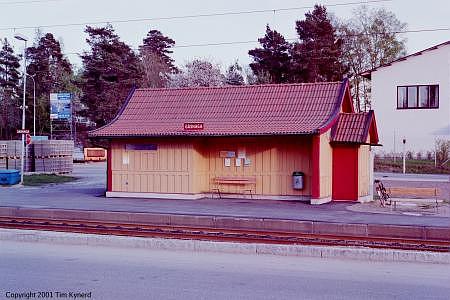
(13 May 2001)
A clear view of the station building and platform at Gåshaga.

(23 August 2000)
Gåshaga brygga under construction. The station platforms
are visible in the distance. At this end of the line, as much construction
work as possible was done before the line was closed on 4 September.
When the line was reopened on 30 October, this station was essentially
complete, except for some signaling details that can't be handled until
the station is put into service in the spring of 2001.

(21 September 2000)
This view is looking timetable south from one of the platforms at Gåshaga
brygga. This end of the line is closed. The single track in
the distance leads to Gåshaga, which is out of sight in this view.
Notice the modern look and the consistent (over)use of yellow.
Skärsätra, the new station that replaced Centralvägen and
Parkvägen, looks very similar.

(21 September 2000)
This view shows both tracks at Gåshaga brygga, with their bumper
posts, and both platforms. The platforms are strikingly long for
Lidingöbanan, because they (like the platforms at Skärsätra)
are built to accommodate two-car trains of A32 stock, the kind used on
Tvärbanan. A three-car train of A30B/B30B stock is about 45
meters long, while two A32s come to about 60 meters. In order to
run A32 stock on Lidingöbanan, a large number of stations and stops
will have to be rebuilt, both to lengthen platforms and to increase the
gap between the platform and the track (A32 stock is wider than A30B/B30B).
Skärsätra and Gåshaga brygga, however, have been built
to accommodate A32 stock without modification, and narrow metal "gap fillers"
have been fitted under the doors of the A30B/B30B stock to minimize the
possibility of accidents at those stations with the older stock in service.
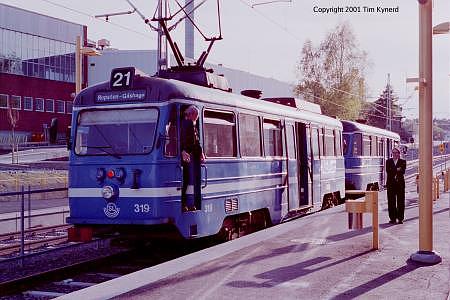
(13 May 2001)
Regular service was initiated to Gåshaga brygga on Monday 7 May 2001.
Here is a train that has just stopped at Gåshaga brygga on the
following Sunday. The driver and conductor have a break of about four
minutes here, and are leaving the train to stretch a bit. (Notice that
the conductor thought it was a bit chilly that day....)

(13 May 2001)
A view of the same train, looking toward the bumper posts and the water.
That's the Baltic Sea, by the way.
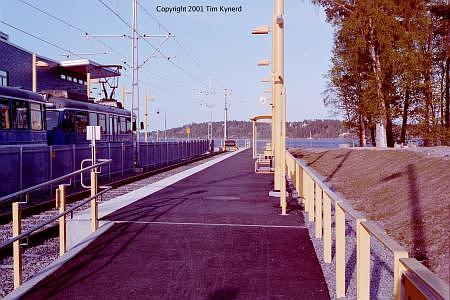
(13 May 2001)
This photo shows platform 2, which is not used for trains in normal service
(at least not with the current timetable), but which for some reason has the
only stop shelter at the station.

(13 May 2001)
Platform 1, with the same train departing.

(13 May 2001)
A view of the bumper post on track 2. You can just see the boat dock used
by the archipelago boats in the distance.
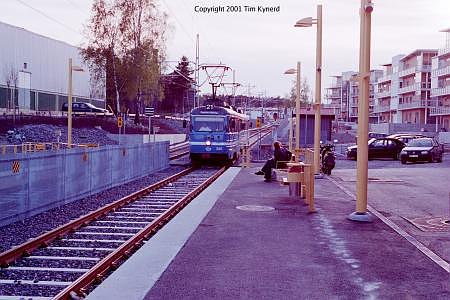
(13 May 2001)
A train arriving at Gåshaga brygga.
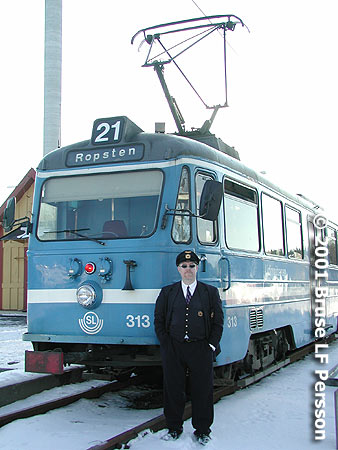
(4 March 2001)
And finally, a picture of me, standing in the snow in front of my train
at Gåshaga. (Taken by my friend Bruse.)
And this ends our tour of Lidingöbanan.