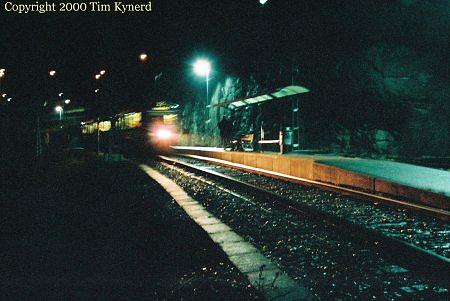
Having seen the Ropsten end of Torsvik station, here are some pictures of Torsvik.
(3 December 2000)
The train shown in this view is fuzzy because it was in motion (coming to a stop as I took the picture). It's northbound (toward Gåshaga), and this picture is looking timetable south, so we're seeing the front of the train. Behind us, the line again becomes single-track to the next station, Baggeby. That single track climbs one of the steepest railroad grades in Sweden.
(3 December 2000)
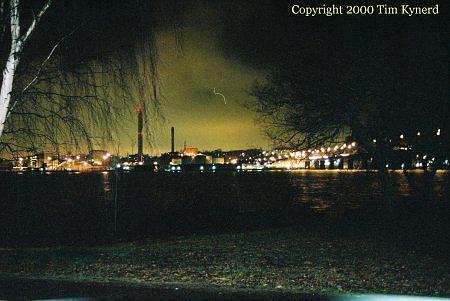
This picture was taken from the pedestrian and bicycle path next to the water, below Torsvik station. It's a view of Stockholm from the Lidingö side.

(23 August 2000)
And here's a northbound train stopped at Torsvik.
Here are some winter pictures of that steep grade, called Herserudsbacken. "Herserud" is the name of a stop that existed until the 1980s in the middle of the grade, and "backe" means hill or grade in Swedish.

(22 December 2001)
This photo is at the bottom of the grade, showing a train departing Torsvik northbound (to Gåshaga brygga).

(22 December 2001)
Here, a southbound train (to Ropsten) on its way to Torsvik.

(22 December 2001)
A northbound train in the middle of the grade.

(22 December 2001)
The rear of the same train as it proceeds toward Baggeby.

(22 December 2001)
Another southbound train on its way down the grade toward Torsvik.

(22 December 2001)
Proceeding down the hill, the train kicks up some snow.
And here are some winter pictures of Baggeby, the station at the top of Herserudsbacken.
(6 February 2001)
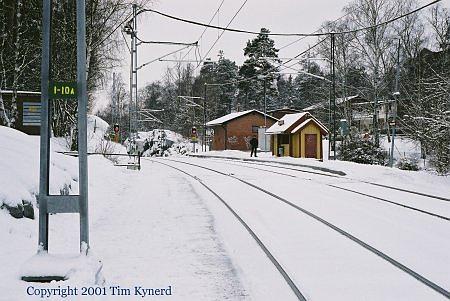
This picture is looking timetable south (toward Ropsten). The red brick
building is a rectifier substation, and the yellow-and-red wooden building
is, of course, the station building.
It's not easy to tell in this view, but signal 22 (on the left) and signal
20 (on the right) are both displaying a red aspect. Signal 22 is not
used for normal traffic; it controls southbound moves from the northbound track
onto the single track that runs down the steep grade to Torsvik. Signal
20 is the one used for normal traffic.
(6 February 2001)
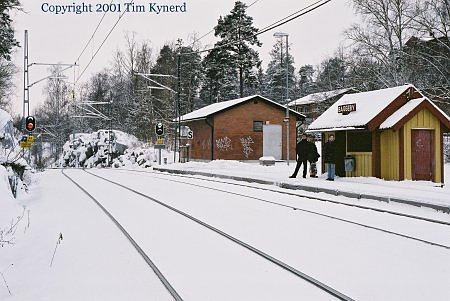
Signal 20 has turned green. A southbound train has departed Bodal, the
adjacent station behind us in this view (timetable north of us), and by so
doing it has "requested" a route from Baggeby all the way to Torsvik.
If another train happened to be northbound at Torsvik and had already gotten
a green signal to depart Torsvik for Baggeby, signal 20 would, of course,
be prevented from displaying a green aspect. A train on the single track
between Torsvik and Baggeby has the same effect. Other things that can
prevent signal 20 from turning green are if the switch just ahead cannot move
into the correct position and lock (it's a motorized switch), or if one of
the signals on the stretch of track between Torsvik and Baggeby has been smashed
by vandals (I've seen it happen more than once).

(6 February 2001)
The southbound train approaches Baggeby. To the right is Baggeby's northbound
platform (for trains to Gåshaga).

(6 February 2001)
The train making its stop at Baggeby.
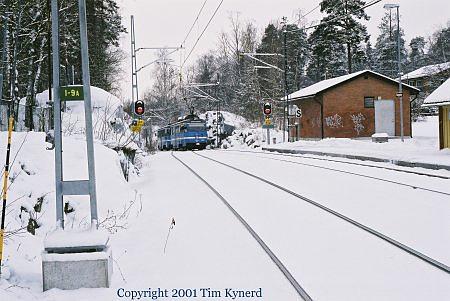
(6 February 2001)
The train departing Baggeby for Torsvik. Signal 20 has turned red behind
the train.
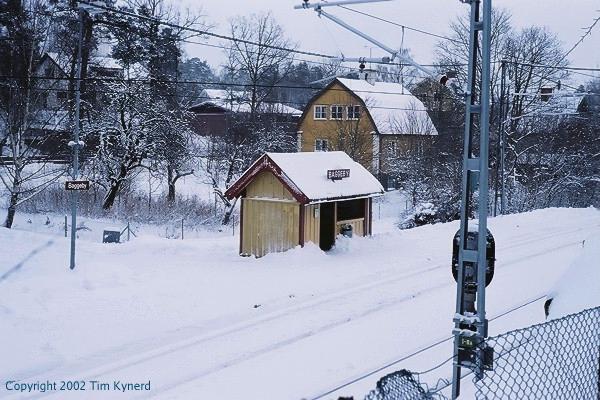
(22 December 2001)
The first of a group I took on 22 December 2001, a very cold Saturday afternoon with a heavy snowfall. This is the station building at Baggeby, seen from above and to the south.
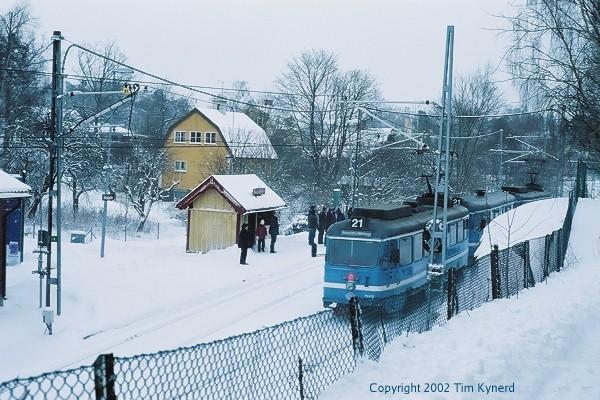
(22 December 2001)
This view from the same vantage point shows a northbound train, as well as passengers waiting for the southbound at the station.

(22 December 2001)
The southbound is arriving as passengers wait to board. It's a safe bet that many of them are heading into Stockholm to do last-minute Christmas shopping. Note that the train has three cars, which isn't usual on a Saturday but is often done on the weekends before Christmas to handle the crowds.

(22 December 2001)
The same southbound train departing Baggeby.